
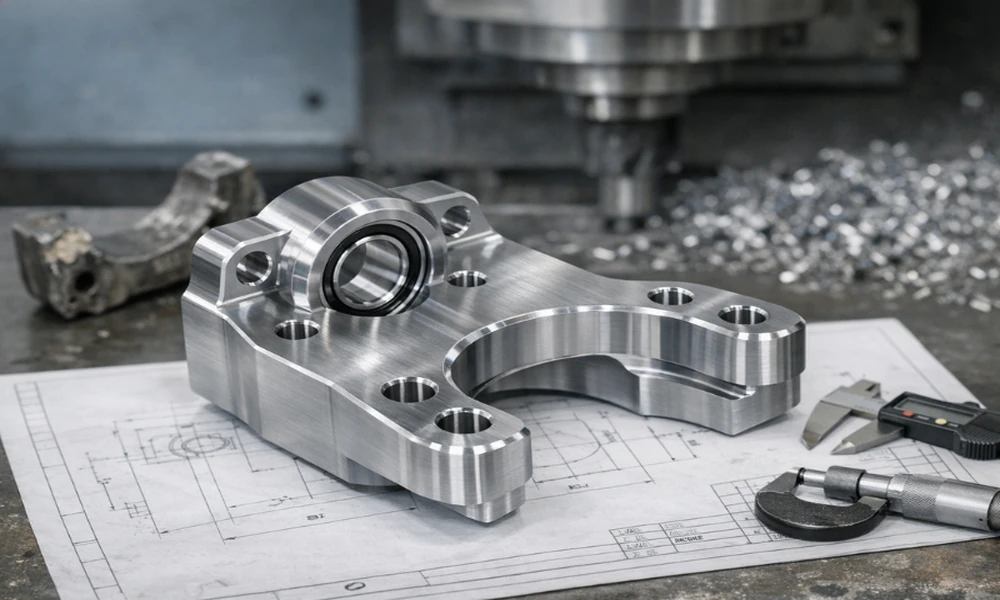
Most custom part manufacturing projects do not fail on the shop floor. In custom metal manufacturing, they usually stall earlier, when a drawing goes out without clear requirements, a prototype is made by a process that can never scale, or nobody agrees on what “approved” means. A part that works beautifully as a one-off can turn into a cost and schedule problem once hundreds or thousands are needed.
Planning the path from prototype to production in stages keeps those surprises small. Each stage answers a specific question, and each one should finish with a decision before money is committed to the next.
What Should You Define Before Requesting Quotes?
Start with the function, not the shape. Write down what the part has to do, what it attaches to, what loads and temperatures it sees, and what environment it lives in. Corrosive exposure, food contact, pressure retention and outdoor service all narrow the material list quickly.
Then capture the commercial facts: expected annual volume, likely lifetime volume, target cost and the date production parts are needed. These numbers matter as much as the drawing. A supplier quoting 50 parts will recommend a very different process than one quoting 50,000 a year, and you only get a useful comparison when every bidder sees the same assumptions.
Finally, decide how the part will be inspected. Agree on datums, measuring methods and which characteristics need recorded data with every shipment. Those choices drive inspection time and cost as much as the tolerances themselves, and settling them before quoting keeps bids comparable.
How Do You Choose a Custom Metal Manufacturing Process That Can Scale?
Custom metal manufacturing covers a wide range of processes: machining from bar or plate, sheet metal fabrication, welding, sand casting, investment casting, die casting and forging. Each has a volume range where it makes economic sense. Machining from solid is fast to start and needs no tooling, which makes it ideal for early prototypes, yet it can become expensive at volume because so much material ends up as chips. Casting carries a pattern or die cost but can bring a near-net shape that needs far less machining.
The mistake to avoid is designing a prototype around one process and then trying to force it into another. If the production intent is a casting, the prototype geometry should already include draft, uniform wall sections and generous radii, even if the first few pieces are machined from solid. A casting manufacturing company can review early models and point out features that would cause shrinkage, misruns or difficult cores long before a pattern is cut.
What Happens During the Prototype Stage?
Prototypes exist to answer questions. Does the part fit the mating assembly? Does it survive the loads? Can it be machined, coated and inspected without trouble? Plan the build so each question has a test attached to it, and record the answers.
It is common to run two or three prototype rounds. The first proves form and fit, often in machined material or a printed pattern. Later rounds use the production material and, where possible, the production process. Rapid tooling, printed sand molds and soft patterns now let foundries produce representative cast prototypes without committing to full production tooling. These parts behave much more like the final product than a machined block does.
Keep revision control strict during this phase. Many projects slip because a supplier builds to an older drawing revision.
How Does Design for Manufacturability Reduce Cost?
Design for manufacturability, usually shortened to DFM, is a structured review in which the supplier’s engineers comment on your design before tooling is built. Typical suggestions include moving a parting line, adding draft, removing a deep pocket that would need a long cutting tool, combining two parts into one casting, or changing a tolerance that adds inspection time without improving function.
A few habits make DFM reviews more productive:
- Share the 3D model as well as the 2D drawing.
- Explain which features are critical and why.
- Ask for cost drivers to be ranked, not just listed.
- Agree in writing which changes are accepted before tooling starts.
Small changes accepted at this point can lower piece price for the life of the part. The same changes made after tooling is built usually mean modifying or replacing that tooling.
What Does Production Approval Involve?
Before full production, most buyers require a first article inspection. The supplier produces parts from production tooling, using production processes, and measures every characteristic on the drawing against its tolerance. Material certifications, heat treatment records and coating test results are typically included in the package. In automotive and some aerospace supply chains, a more formal approval process applies, with process capability studies and documented control plans.
A short pilot run often follows. It shows whether the process holds tolerances over many parts rather than a hand-picked few, and it exposes problems with packaging, labeling and delivery logistics. Treat pilot findings seriously. Fixing a fixture or a gating issue now is far cheaper than sorting defective parts at your receiving dock later.
Who Should Handle Each Step of the Build?
Some projects are best served by a single custom metal supplier that casts, machines, finishes and inspects under one roof. Others split the work, for example sending castings to one source and assembly to another. One accountable source simplifies communication, while a split arrangement may offer more pricing flexibility at the cost of extra coordination and freight.
If your part is mainly sheet, plate or welded structure, a custom metal fabrication manufacturer is the natural fit, and the main things to confirm are welding procedure qualifications, inspection capability and capacity at your target volume. For cast and machined parts, look for experience with similar alloys and sizes, and ask how the supplier handles engineering changes after production begins.
How to Keep a Custom Part Program on Schedule After Launch
Production approval is a milestone, not a finish line. Agree on a clear engineering change process so that any revision to geometry, material or process is reviewed and approved before parts ship. Share demand forecasts regularly, since castings and long-lead materials need planning time. Keep the approved first article package on file, because it becomes the reference point for every quality question that comes up over the life of the part.